|
Cost Segregation for Commercial & Short-Term Rental Owners
|
Request a free estimate [email protected] |
Guides & Tools
FREE Estimate Is there a first-year deduction sitting in your building? No cost, no obligation. Request Yours »Minimum ROIOur study identifies at least 20x its fee in first-year deductions on commercial property, or at least 30x on a short-term rental, or it is free. |
What Do Reddit and BiggerPockets Really Say About Cost Segregation?Quick answer Reddit, BiggerPockets, and Bogleheads are full of owners asking the same questions before they sign: does cost segregation actually work for a W-2 earner, why do two firms quote wildly different numbers, and what happens when the property sells. The stories below are paraphrased from those public threads and attributed to their forum, not Basis client results. Read together, they show a mechanism that works exactly as designed, and a sales pitch that regularly outruns it. See this applied to your building. A few questions, 30 seconds. You see which tests matter and the first-year deduction range a study would look for. No email to see the range. Run the 30-second check »Key takeaways
Steven's Take I read the same threads you do before you find this page, and I built it because most of what shows up there is either accurate and unpolished or confident and wrong. The stories are paraphrased from public forums, attributed to where they came from, never claimed as our clients. Read them for the mechanism, not the specific numbers. A stranger's thread is not your building's estimate, and that is exactly what the free one is for. Steven Ellis, Founder The $68,000 Estimate That Became $8,500 in the RepliesA BiggerPockets investor in Long Beach, California, owns 5 properties and expected W-2 income under $100,000 for the year. A provider ran a preliminary estimate: $177,000 in increased depreciation and $68,000 in estimated year-one tax savings, for an $18,000 fee. In her own post she wondered whether she was "supposed to be wooed by it." An independent accountant answered in the replies with the actual bracket math, in public, before she spent a dollar. The provider's number assumed roughly a 38% tax bracket. Because California does not conform to federal bonus depreciation, the real combined rate ran closer to 24% federal and 9.3% state, and the passive activity rules cap the usable loss for a W-2 earner without real estate professional status at $25,000 a year. Run through those two corrections, the accountant put real first-year savings closer to $8,500. A second, well-known accountant on the thread confirmed separately that a regular W-2 employee without a qualifying spouse would not qualify as a real estate professional at all. Whether a study's deduction can actually reach W-2 wages runs through the same gates the accountant applied by hand, in a forum reply, for free. (BiggerPockets thread) 
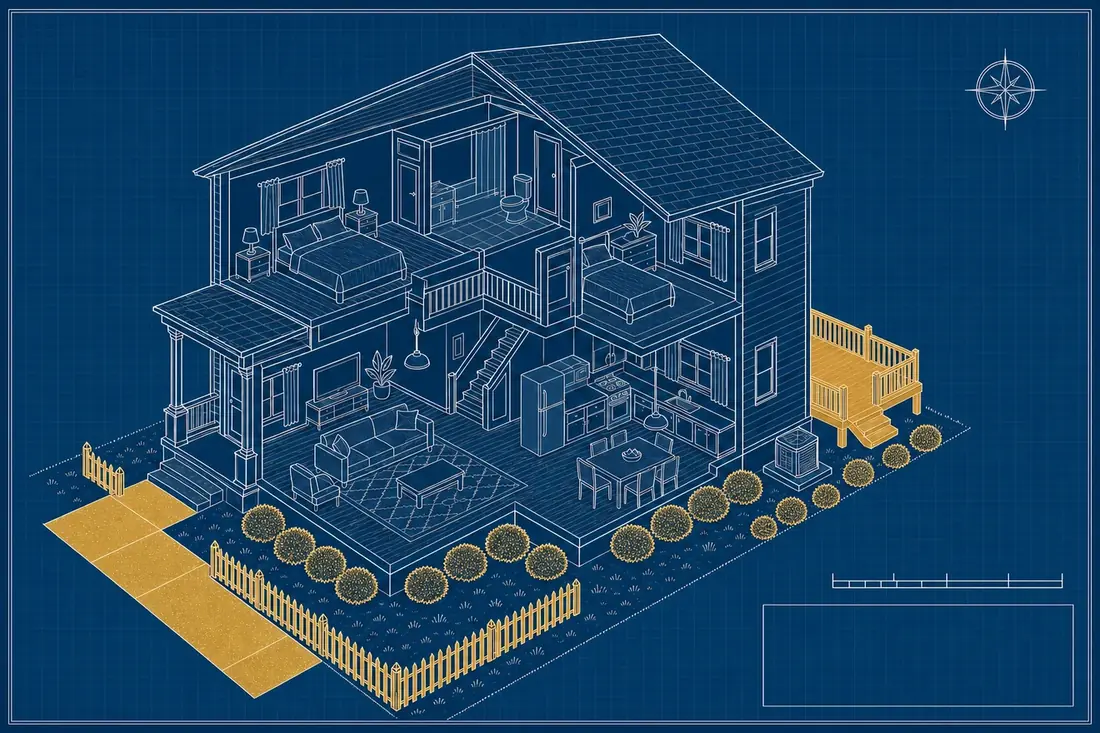
5-Year: carpet and flooring, cabinets, appliances, light fixtures, curtains 7-Year: furniture 15-Year: driveway, fencing, landscaping, deck 27.5/39-Year Shell: roof, load-bearing walls, foundation, central HVAC Get your free Preliminary Benefit Estimate Before trusting a stranger's estimate in a thread, get a free Preliminary Benefit Estimate modeled on your own building. Request Your Free Estimate »The Landlord Who Was Still Depreciating Five Roofs She'd Already Torn OffA 15-year rental property investor in Joliet, Illinois, replaced five roofs across her portfolio and, at first, treated each one as a simple capital improvement. Then she asked herself a question in a BiggerPockets post: "Why am I still depreciating an asset that I no longer own?" The old roofs' remaining tax basis was still sitting on her depreciation schedule years after the roofs themselves were torn off and hauled away. Working from her own portfolio's cost data, roofs running about 5.5% of building replacement value, she calculated the leftover basis herself and reported a combined $9,102 loss on Form 4797, the form for reporting a sale or disposition of business property. An accountant replying in the thread called this move, a partial asset disposition, meaning the write-off of a replaced component's remaining basis in the year it comes out, "one of the most commonly missed tax benefits in real estate," and noted that a cost segregation study makes the math easier because it already assigns a basis value to each component. A renovation creates this exact double move: new construction to classify, and an old component's basis to release, but only in the same tax year the old one comes out. (BiggerPockets thread) Two Firms Quoted the Same Fourplex Nearly Double Each OtherA BiggerPockets member bought a four-unit building in Columbus, Ohio for $350,000 and replaced the roof. She collected quotes from two named firms. One estimated a $75,000 to $95,000 reduction in taxable income. The other came in at $40,000 to $60,000, telling her they preferred to "under promise and overdeliver." Unsure whether the gap was honesty or salesmanship, she asked the forum. A specialist ran the sanity check live in the replies: roughly 20% land value leaves about $280,000 in depreciable building basis, and a four-unit property typically reclassifies 28% to 38% of that basis into faster schedules once unit-level components are multiplied across four units. That band puts the higher quote inside the expected range and makes the lower quote's implied reclassification look conservative for a building that size. The same specialist also flagged whether either firm had included a partial asset disposition election for the roof she had just torn off, the same mechanic that surfaced above. Seeing the actual reclassification math, not the better-sounding number, closed the gap for her. (BiggerPockets thread) Two "It Depends" Stories: A Renovation and a MarriageA BiggerPockets member in Boston gut-renovated her primary home and planned to short-term rent it 5 to 6 months a year, just under her town's cap on primary-residence use. She hoped a cost segregation study plus bonus depreciation would offset a $75,000 tax bill. A CPA replying in the thread was direct: her own personal-use days on the house are far above the threshold that would let the loss reach anything beyond the rental's own income. Section 280A caps the deduction once personal use crosses that line. (BiggerPockets thread) A second BiggerPockets member, a high-earning W-2 employee, had just married a woman who qualifies as a real estate professional for her own rental LLC. His own accountant told him filing jointly "has no benefits." Seven other professionals piled into the replies, nearly all saying: get a second opinion. One reply pointed out that real estate professional status alone does not automatically make rental losses deductible against W-2 income; the spouse also generally needs to materially participate, meaning real, regular involvement in that specific rental, before cost segregation's accelerated loss can do anything for the household's W-2 income at all. (BiggerPockets thread) The 60-Second Qualifier Four questions. Our engineering team's model shows the estimated first-year acceleration a study of your property would target, free, before you commit to anything. Take the Qualifier »The $400,000 Number and the Word "Loophole," Both Put to the TestA tax and financial services professional posted the internet's favorite claim on BiggerPockets: a single short-term rental "can create $400K in tax benefits." He admitted he "didn't believe it either" at first. The reply came from someone with a direct stake in the answer, a partner at an actual cost segregation firm, who did not deny the mechanism, calling it real and "one of the most underused provisions in the code." He then narrowed the headline hard: whether one property can really produce $400,000 "depends entirely on which number you mean." He grounded the underlying 7-day exception in the actual regulation, Treas. Reg. 1.469-1T(e)(3)(ii)(A), and pointed out no real estate professional status or 750 hours is required for this specific path. (BiggerPockets thread) A separate, widely read post took the word itself apart. A tax accountant and enrolled agent with more than 5,500 BiggerPockets posts opened his mythbusting thread on the "STR loophole" by rejecting the premise outright: it is not a loophole, he wrote, since loopholes are unintended and short-term rentals work this way "intentionally, by design." That reframe rests on the same average-stay regulation above, decades old. (BiggerPockets thread) "Is My Building Even Big Enough?" and Other Questions People Keep AskingA BiggerPockets member in San Jose was evaluating a 7-unit, $600,000 apartment building and had absorbed a common myth: that cost segregation only makes sense for expensive buildings. The top reply, from an accountant with 580 forum votes, never answered with a dollar figure, reframing the question instead: is the owner a real estate professional, and what would accelerated depreciation do relative to her whole portfolio. Size was never the real variable. (BiggerPockets thread) On r/realestateinvesting, a single-house owner liked the size of a year-one deduction cost segregation could produce. The replies warned about the flip side: that same acceleration becomes a bigger taxable gain if the property sells within roughly 7 years, since recapture at sale is measured against whatever basis got pulled forward early. The deduction was the hook; the recapture was the catch nobody mentioned up front. (Reddit thread) Three other questions repeat across dozens of threads. "Has anyone heard of this company?" shows up almost word for word on separate threads about two different providers, since vendor trust runs deeper than the tax mechanics here. "Get a second opinion" is the single most repeated advice given to anyone told no by their own accountant. And "is this engineering-based, or a calculator?" comes up often enough that most posters asking it do not yet know the difference. What These Threads Get Right, and What They MissOne pattern stands out. Most posters here were mid-decision: comparing quotes, vetting a provider, asking whether their own facts qualify, not reporting back after the fact with a finished number. No account of a completed multi-year look-back study, meaning a study claimed on a property owned for years through a single catch-up deduction, showed up anywhere. What did show up were partial asset disposition stories, a same-year cousin of the same idea. A Bogleheads member, fresh off a podcast "hyping up the benefits" of cost segregation, asked the forum for a reality check before believing any of it. That instinct runs through nearly every thread here, and it is the right one. (Bogleheads thread) The mechanism these owners describe has a court history: the IRS lost Hospital Corporation of America v. Commissioner in 1997 and publishes its own Audit Techniques Guide. The size of the benefit is never a fixed number; it is a set of tests run against one specific building and one owner's facts. Benchmark runs, with the fee and the ratio attached, are the kind of after-the-fact reporting these forums are visibly missing. Frequently asked questionsIs cost segregation legit, or is it just internet hype? The IRS lost the argument that a building is one undepreciable asset back in 1997, and it now publishes its own guide describing how a proper study works. What varies is the size of the benefit for a specific owner, which depends on tests like real estate professional status, material participation, and average stay length, not on marketing copy. Why did two cost segregation firms give me completely different quotes? Different firms sometimes assume different reclassification percentages before an engineer has actually looked at the building's construction. A four-unit property, for instance, typically reclassifies somewhere between 28% and 38% of its depreciable basis, so a quote well below that band may be conservative, and a quote well above it is worth asking how they got there. The honest fix is asking each firm to show the math, not just the number. Can a W-2 employee actually benefit from cost segregation? Sometimes, and the size depends on which gate applies. Without real estate professional status or the short-term rental exception, a W-2 earner's rental losses are generally capped at $25,000 a year under the passive loss allowance, and even that phases out at higher incomes. Clearing real estate professional status or the short-term rental exception, plus material participation, opens the door wider. Which gate applies to a specific return is a question for a CPA, not a forum thread. Are the numbers people post on Reddit and BiggerPockets accurate? Some are, some are sales estimates that have not been checked yet. The most useful threads in this roundup show independent accountants or specialists checking a provider's number in public, in the replies, before anyone paid a fee. That is the habit worth copying: treat a first estimate as a starting point, not a final answer, and ask what assumptions, tax bracket, state conformity, and qualification status, went into it. What happens if I sell a property soon after a cost segregation study? A short hold does not erase the benefit, but it changes the math. Accelerated depreciation on the personal-property portion recaptures at ordinary rates when the property sells, and the straight-line portion is taxed as unrecaptured section 1250 gain up to 25%. Several forum threads specifically warn new owners about this side of the mechanic, since it is the part a slick year-one number tends to leave out. Keep readingGet your free Preliminary Benefit Estimate Send the address or the listing link. We model the number first; you decide with it in hand. Request Your Free Estimate »Educational information, not tax advice. This page describes how federal
depreciation rules and tests work in general. Whether any rule fits your facts is a determination for
you and your CPA. Our study gives your CPA the engineering and the numbers to make that call.
|