|
Cost Segregation for Commercial & Short-Term Rental Owners
|
Request a free estimate [email protected] |
Qualification
FREE Estimate Is there a first-year deduction sitting in your building? No cost, no obligation. Request Yours »Minimum ROIOur study identifies at least 20x its fee in first-year deductions on commercial property, or at least 30x on a short-term rental, or it is free. |
Can You Take Bonus Depreciation on Rental Property?Quick answer Yes. Bonus depreciation under section 168(k) applies to any qualifying property with a recovery period of 20 years or less, regardless of whether the building around it is a residential rental (27.5-year) or a commercial property (39-year). That includes the 5-, 7-, and 15-year components, carpet, cabinetry, decorative lighting, certain electrical and plumbing, paving, fencing, landscaping, that a cost segregation study identifies inside almost any rental building. Under the 2025 OBBBA law, 100% bonus depreciation is restored and made permanent for property acquired after January 19, 2025. See this applied to your building. A few questions, 30 seconds. You see which tests matter and the first-year deduction range a study would look for. No email to see the range. Run the 30-second check »Key takeaways
The Short Version: Yes, With One ConditionBonus depreciation reaches rental property. The condition is about the asset, not the building: section 168(k) allows an immediate deduction for a percentage of the cost of qualifying property with a recovery period of 20 years or less. A rental building's own structural shell, 27.5 years for residential, 39 years for commercial, sits outside that window and depreciates on the standard straight-line schedule. Everything a cost segregation study reclassifies out of that shell, into 5-, 7-, or 15-year property, sits inside the window. 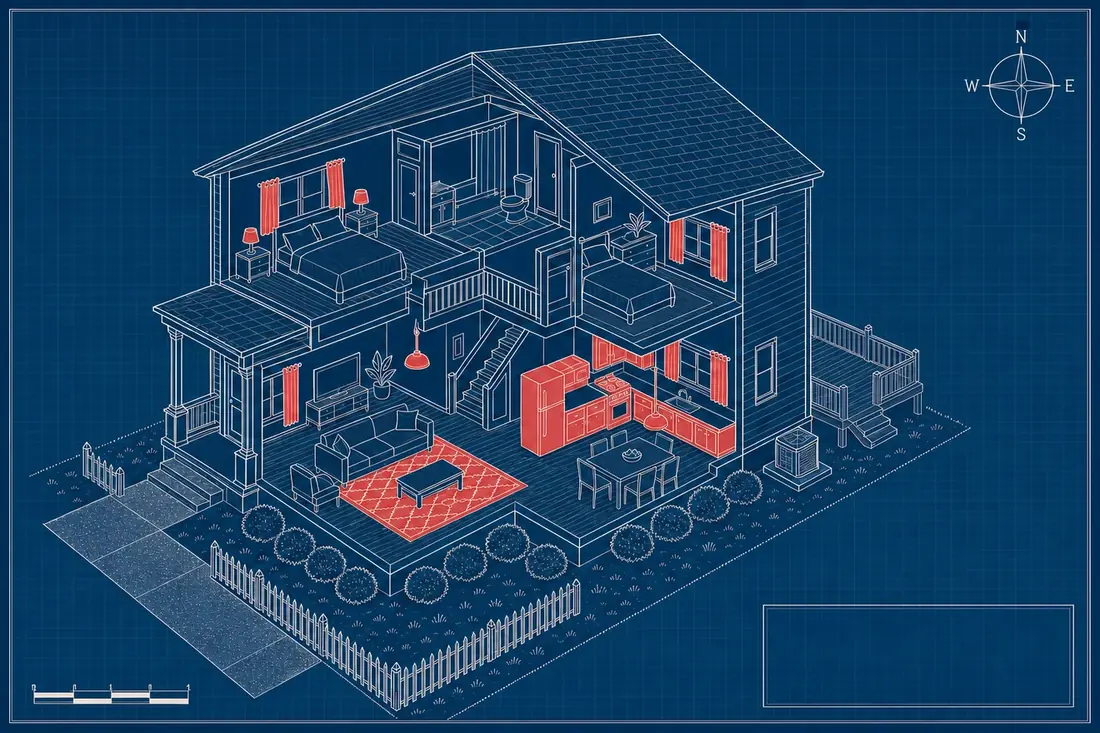
5-Year: carpet and flooring, cabinets, appliances, light fixtures, curtains 7-Year: furniture 15-Year: driveway, fencing, landscaping, deck 27.5/39-Year Shell: roof, load-bearing walls, foundation, central HVAC Get your free Preliminary Benefit Estimate Run the free estimate to see what our engineering team expects bonus depreciation to find inside this specific building before any commitment. Request Your Free Estimate »What Actually Qualifies Inside a RentalA cost segregation study looks at a rental building and separates the components that qualify for shorter recovery periods from the structural shell around them. Carpet, most flooring, decorative lighting, cabinetry, appliances, window treatments, and certain electrical and plumbing that serve specific equipment land in 5-year property. Certain furniture and fixtures land in 7-year. Paving, fencing, landscaping, site utilities, outdoor lighting, and pools or patios land in 15-year land improvements, distinct from land itself, which is never depreciated. Every one of those categories has a recovery period of 20 years or less, which is what makes them bonus-eligible. The Rule That Changed: OBBBA and the 100% RestorationBonus depreciation has moved by statute several times in the last decade. Under the 2025 One Big Beautiful Bill Act (OBBBA), 100% bonus depreciation is restored and made permanent for qualifying property acquired after January 19, 2025. Property acquired between 2023 and January 19, 2025 sits on the earlier phase-down schedule, 80%, then 60%, then 40%, that predated the restoration. The acquisition date, not the placed-in-service date alone, is what determines which rate applies to a specific asset. Before the restoration, owners timed acquisitions around the phase-down calendar, rushing to close before a rate step-down took effect. That planning pressure eased once OBBBA made the 100% rate permanent going forward, though it didn't erase the earlier window: a property acquired in 2024, for instance, is locked into whatever rate applied on its specific acquisition date regardless of when it's placed in service or when a study eventually runs on it. 100%bonus rate for property acquired after Jan 19, 2025 20 yrsmaximum recovery period for bonus-eligible property A Delivered Example on a Residential RentalA single-family rental in Montgomery County, Pennsylvania, built in 2013 at 4,946 square feet, carried a depreciable basis of $1,040,000. A cost segregation study on that property, produced by our engineering team, identified $160,242 of the basis, 15.4%, that belonged on faster schedules instead of the standard 27.5-year residential track. Estimated first-year depreciation came to $174,905, 16.8% of basis, once 100% bonus depreciation was applied to the reclassified components. The fee for that study was $1,295, which puts the first-year deductions at roughly 135 times the fee. That property is residential rental property, not commercial, and every dollar of the $160,242 reclassified still cleared the identical 20-year-recovery-period test that governs bonus eligibility on a warehouse or a restaurant. The $174,905 first-year figure came from two pieces: bonus depreciation on the newly reclassified components, and, because this ran as a look-back study on a property already in service, a section 481(a) catch-up covering the depreciation those same components should have carried in prior years. Both pieces run through the identical bonus-eligibility rule; the look-back mechanism only changes when the deduction shows up, not whether the components qualify. The 60-Second Qualifier Four questions. Our engineering team's model shows the estimated first-year acceleration a study of your property would target, free, before you commit to anything. Take the Qualifier »Why the Building's Own Schedule Doesn't Block ThisBonus depreciation runs on the asset's own recovery period, not the shell's. A 27.5-year residential building and a 39-year commercial building both hold 5-, 7-, and 15-year property inside them, and both sets of components qualify the same way. That design isn't an accident: bonus depreciation was built around the asset's own recovery period specifically so a structural classification dispute, residential versus commercial, wouldn't become a threshold fight before an owner could even get to the depreciation question that actually moves the return. A component either has a recovery period of 20 years or less or it doesn't; the building wrapped around it is irrelevant to that determination. The full residential-versus-commercial comparison lines up the mechanics and the typical bucket mix side by side for both building types. What Bonus Depreciation Doesn't ReachBonus depreciation has no effect on the structural shell itself, the 27.5-year or 39-year portion of the building, which keeps depreciating on the standard straight-line schedule regardless of what happens to the components around it. It also doesn't require the active-trade-or-business standard that limits Section 179 on rental property, which is one reason bonus depreciation ends up doing more of the work for a typical rental than section 179 does. Land is the other thing bonus depreciation never reaches, for a simpler reason: land isn't depreciable property under any schedule, bonus or otherwise. A cost segregation study excludes land value before it classifies anything else, which is why the site improvements it does find, paving, fencing, landscaping, sit on land rather than being land themselves. How This Plays Out on a Property Already OwnedBonus depreciation isn't limited to the year a property is purchased. A look-back study on a property owned for years identifies the same components retroactively, and the missed depreciation from all those prior years is claimed through Form 3115 with a section 481(a) catch-up deduction in the current year, no amended returns required. How a look-back study gets claimed covers that filing mechanism directly. Picture the Montgomery County property above as a look-back candidate instead of a same-year purchase: an owner who bought it years earlier and never ran a study could commission one later, have the same $160,242 identified, and claim the prior years' missed depreciation as a single catch-up deduction in the year the study completes, rather than filing amended returns for each of those earlier years. Frequently asked questionsDoes bonus depreciation apply to a rental property purchased used, not new? Yes. Since the 2017 tax law, bonus depreciation applies to both new and used qualifying property, as long as the taxpayer didn't previously use that specific property. A rental building purchased on the resale market qualifies the same way a newly constructed one does, for the components identified inside it. What's the difference between bonus depreciation and cost segregation? A cost segregation study is the classification step: it identifies which components of a building belong on 5-, 7-, or 15-year schedules instead of the 27.5- or 39-year shell schedule. Bonus depreciation is the deduction-timing rule that then lets those classified components be expensed immediately instead of depreciated over their recovery period. Does bonus depreciation phase out over time? It has in the past. Property acquired between 2023 and January 19, 2025 falls under an earlier phase-down (80%, then 60%, then 40%), but the 2025 OBBBA law restored the 100% rate and made it permanent for qualifying property acquired after January 19, 2025. Can bonus depreciation create a loss on a rental property? Unlike section 179, bonus depreciation isn't limited by business income in the same way, though the resulting loss still runs through the passive activity rules under section 469, which limit how a rental loss can be used against other income. That's a separate question from whether the deduction itself is available. Does a short-term rental get the same bonus depreciation treatment as a long-term rental? The component-level rule doesn't distinguish between them. A cost segregation study identifies the same categories of 5-, 7-, and 15-year property in a short-term rental as in a long-term one; what differs between the two is usually the mix and proportion of those components, not their bonus eligibility. Keep readingGet your free Preliminary Benefit Estimate Send the address or the listing link. We model the number first; you decide with it in hand. Request Your Free Estimate »Educational information, not tax advice. This page describes how federal
depreciation rules and tests work in general. Whether any rule fits your facts is a determination for
you and your CPA. Our study gives your CPA the engineering and the numbers to make that call.
|